
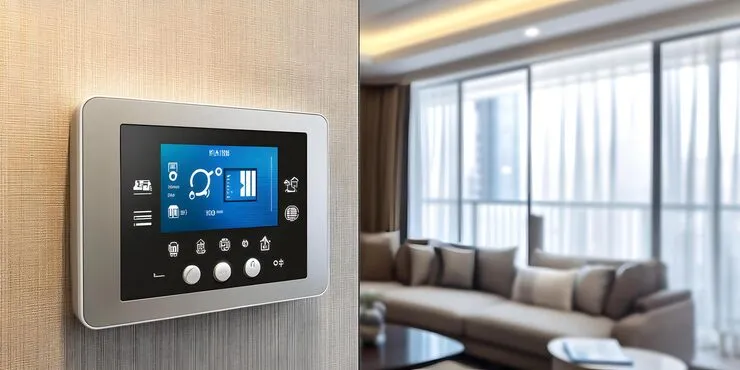
The intercom is the most-used piece of security hardware in most offices and the least thought-about. Every visitor, courier and contractor arrives through it. Yet it is often the oldest technology in the building — an analogue handset wired to a buzzer, installed once and never reconsidered.
IP intercoms changed what that device can be. Instead of a standalone buzzer, the intercom becomes a networked endpoint that ties into your access control, your CCTV, and increasingly the phones your staff already carry.
What “IP” changes
An analogue door phone does one thing: it connects the door to a fixed handset inside. If nobody is at that handset, nobody answers the door.
An IP intercom runs over your network, and that single change cascades:
- Calls can route anywhere — to a reception desk, to multiple handsets, to a mobile app, or to a softphone on a PC. A visitor pressing the button can reach whoever is actually available, not just whoever is standing by one specific handset.
- Video comes as standard. You see who is at the door before opening it, and the call can be recorded.
- It integrates with door release, so answering and unlocking happen from the same interface.
- It ties into CCTV, associating a door-call event with camera footage automatically.
The integration that matters most
The real value appears when the intercom stops being a separate system and becomes part of one connected entry solution. Picture the sequence: a visitor presses the intercom, a video call routes to reception and simultaneously to a mobile app, the associated CCTV camera begins recording, reception sees and speaks to the visitor, and a single tap releases the door — with the whole event logged against the access control system. No separate buzzer, no walking to a fixed handset, no wondering later who was let in and when.
For offices running visitor management, the intercom becomes the front end of that process rather than a disconnected first step.
What to specify for a Dubai office
Video, not just audio. The marginal cost is small and the security benefit is large.
Mobile app routing if your reception is not always staffed, or if you want after-hours calls to reach someone. This is often the single most appreciated feature day to day.
PoE power. An IP intercom drawing power over its network cable means one cable, not two, and no separate power supply at the
door — which matters for a clean installation.
Weather and vandal resistance appropriate to the mounting position. An entrance exposed to sun and the occasional knock needs a rating that reflects it.
Integration with your existing access control and CCTV, rather than a closed system that only talks to its own manufacturer’s kit. Ask specifically whether the intercom uses open standards or a proprietary protocol.
A note on scale
For a single-door office the benefit is convenience and a video record. For a multi-tenant building, multiple entrances, or a site with a barrier and a reception, IP intercoms scale in a way analogue systems cannot — one platform managing every entry point, with calls routed intelligently and every event logged centrally.
The bottom line
The intercom is worth more attention than it usually gets, because it sits at the exact point where people enter your premises. An IP
intercom turns that point from an isolated buzzer into an integrated part of your security — video-verified, routable to wherever your people actually are, and logged alongside your access control and CCTV.
KNH IT is a SIRA Approved provider of IT, networking and ELV solutions for businesses across Dubai. For a consultation, contact our team at Al Raffa Building, Office 07, Bur Dubai.

